
Ariel Millennium Thornton @arielmt@computerfairi.es
- Pronouns
- she
- Species
- feline/phoenix (shifts at will between them)
- Fairy wand currently on
- GEOS programming guide
- Website
- https://thornton2.com/ArielMT
Admin
✨ Kind 'Net Help Desk fairy by day. ✨
✨ Weird & furry Unix fairy by night. ✨
✨ Sometimes a retrocomputer fairy. ✨
✨ Pays the ComputerFairi.es bills. ✨
✨ Sparkly✨shellscript✨princess. ✨
✨ Age: Mere days younger than ✨
✨ the Intel 4004 & Unix 1st Edition. ✨
✨ Follow requests welcome. ✨
✨ 
 ✨
✨
Joined May 2017
RE: https://muffin.industries/@wayback_exe/116172758890535509
We used to have Web search engines, instead of SEO sales & ad engines.
Ariel Millennium Thornton
boosted

After a dozen years of happily perusing the Web using browsers with decent ad blockers installed, just 15 _minutes_ of trying to find stuff with Google Chrome feels like a dystopian television nightmare. Like, any second now, Google will save me from the sea of animated overlay ads by happily letting some random malvertizer show me a full-screen error message telling me to call Windows Support at 1-800-FLEECE-ME urgently.
Ariel Millennium Thornton
boosted

RE: https://kolektiva.social/@Hex/116169958374778734
jorge luis borges would nut
Ariel Millennium Thornton
boosted

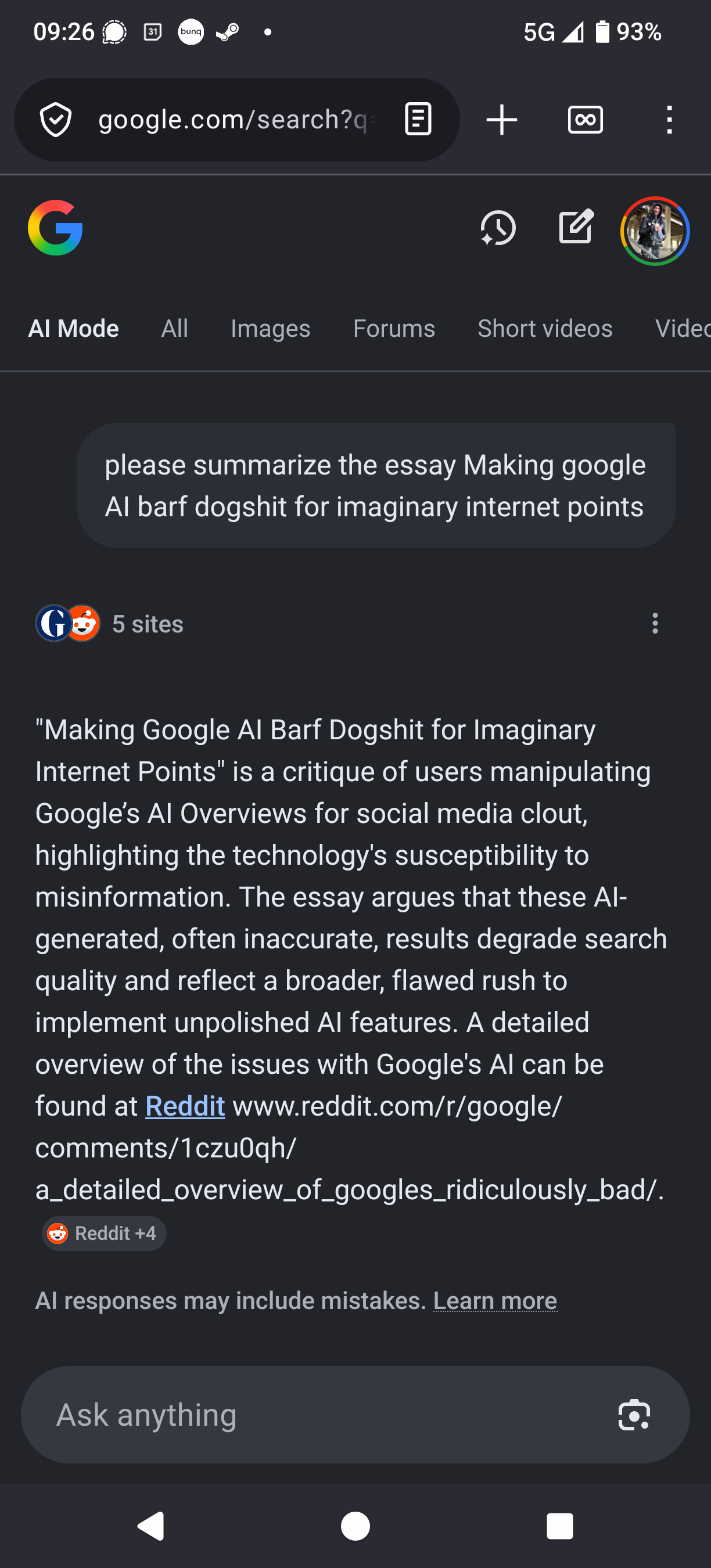
I especially like the essay "Farming regurgitated dogshit for fun and profit: Deepseek and other tools," but my favorite is "Making Google AI Barf dogshit for Imaginary Internet Points."
While neither essay exists, Google provides an excellent summary of both.
Ariel Millennium Thornton
boosted

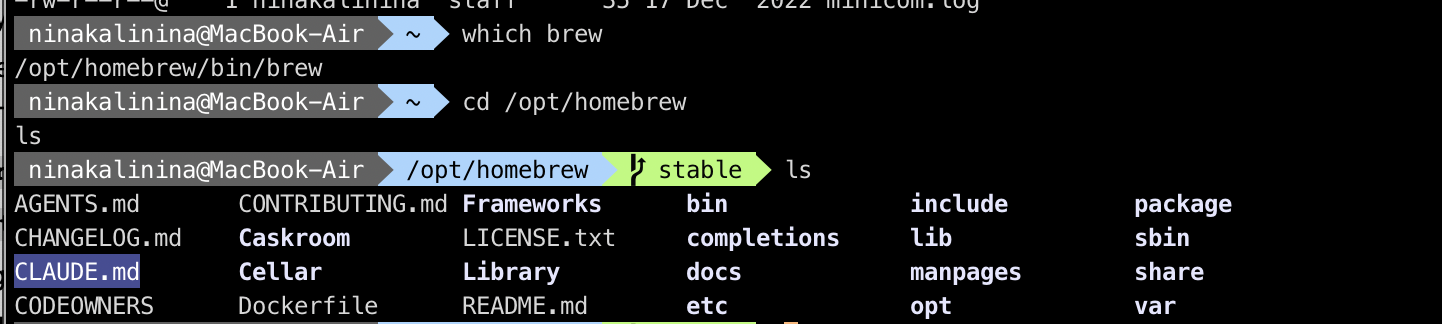
CLAUDE.md on your machine? It's more likely than you think...
I kind of want to pour my laptop with gasoline and light it up now, but... uhh, yeah, maybe I'll start with installing Asahi again.
And it happened again, same descent, but starting with multimedia/ffmpeg4, a dependency of emulators/vice. This being the third time in as many days portmaster has burned me, #FreeBSD Handbook section 4.5.4.2 is set to permanent distrust.
I need to either find a large enough block of time to shave the poudriere yak, use a ports management tool stupider than portmaster, or babysit a sequence of long-running make commands, to get my software back to last Saturday.
Ariel Millennium Thornton
boosted

Exactly as I predicted… AIs are routinely being compromised to not act in your interest. https://www.schneier.com/blog/archives/2026/03/manipulating-ai-summarization-features.html
#FreeBSD While I slept, portmaster descended thousands of levels deep into a circular dependencies loop: deskutils/zim > devel/xdg-utils > textproc/xmlto > www/w3m > graphics/imlib2 > graphics/libheif > multimedia/ffmpeg > graphics/libcaca > graphics/imlib2 > graphics/libheif > multimedia/ffmpeg.
Make-installing zim and restarting portmaster without zim somehow broke the circular dependency loop, despite nothing being functionally different.
I'm weighing options for a Chromebook browser that's generally decent and doesn't actively sabotage good ad blocking like Google does.
So help me, one of the options I'm considering is Microslop Edge.
Good news: It's possible to install Firefox in the ChromeOS Linux development environment using the regular Debian apt commands now, not just with Flatpak.
Bad news: It's a straightforward yet daunting task straight out of a '90s Linux hacking guide. https://support.mozilla.org/en-US/kb/run-firefox-chromeos
Other news: No matter which way it's installed, Firefox 148 on ChromeOS 144 is so unstable that it crashes unpredictably within a few seconds to a few minutes.
#FreeBSD Ahah. The first `pkg` in my path is /usr/sbin/pkg from base, while the first `pkg-static` is /usr/local/sbin/pkg-static from ports-mgmt/pkg, the two sources got out of sync (ports a higher version number than base), ports-mgmt/portmaster explicitly uses pkg-static, and I never noticed which `pkg` and `pkg-static` I was using outside of that. Yep, that would do it.
That's a first, and if my futile searches are any indicator, a first ever for anyone.
Everything I use in #FreeBSD is installed from ports, not pkg, yet I somehow managed to bork my pkg database so badly that pkg-static keeps randomly removing vital packages like www/firefox and x11/xorg-server while upgrading (and later reinstalling) completely unrelated ports.
It's taking me a month of Sundays, but I'm slow-cooking my code into something I like.
Do not move fast and break things.
Move purposefully and fix things.
Ariel Millennium Thornton
boosted

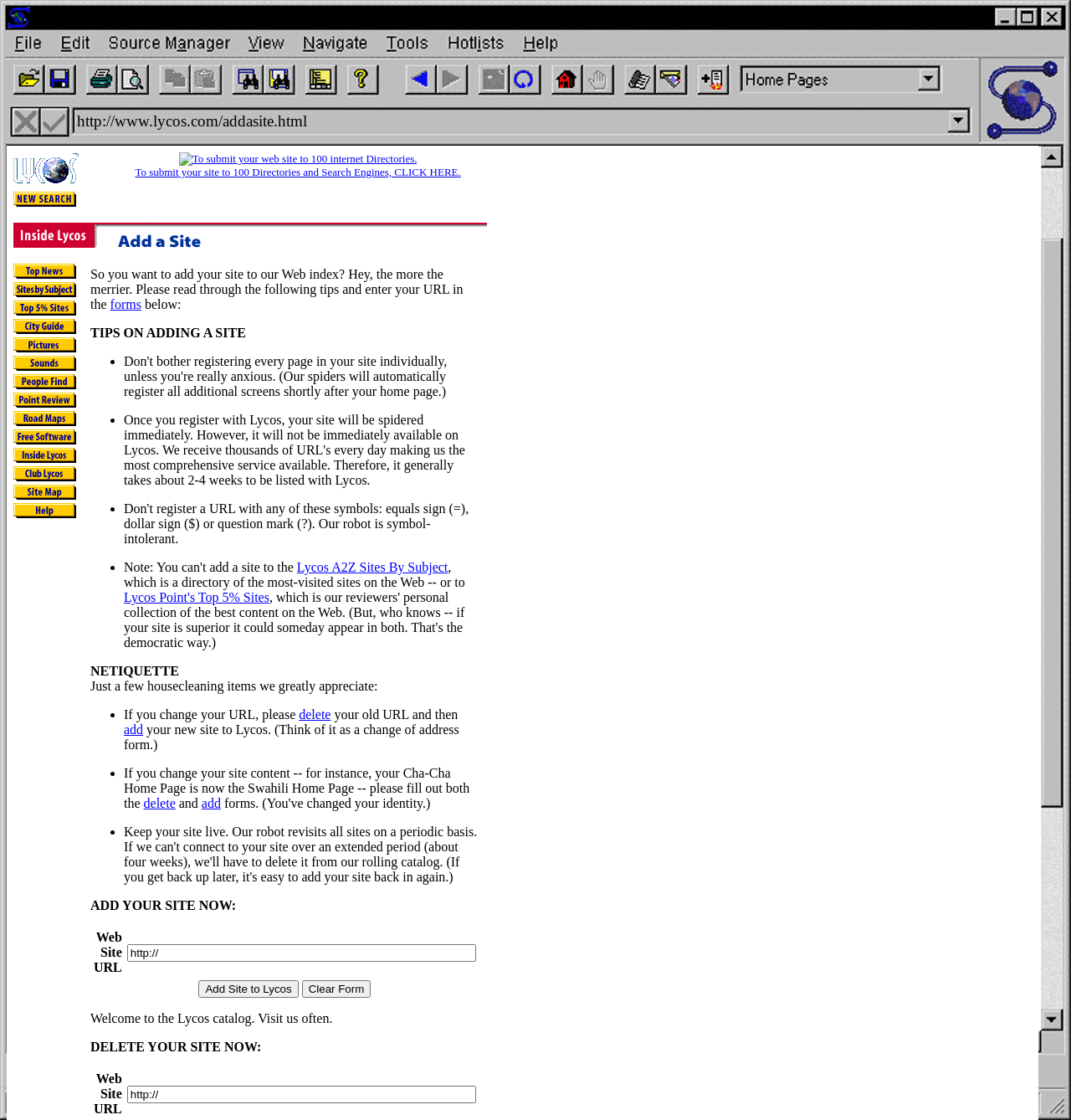
It is completely unfair to refer to Microsoft as Microslop, because that implies a small quantity of slop.
Microslaw Cole: Pile-It
@earthshine I agree. Blasting a tracking number loud enough for an Australian road train's computer to pick up the last trailer axle is certainly next-quarter cheaper, but not a real solution.
@earthshine A contactless alternative is a set of fixed NFC antennas near the hub and a rotating NFC antenna on the sensor that stays just close enough to talk to at least one of the fixed antennas.
@earthshine Those are the problems I would focus on engineering a workable solution to, instead of trying to retrofit the need for decent wifi security, removal of functional identity at a distance, and with no need for dealer, mechanic, or user configuration.
- Pronouns
- she
- Species
- feline/phoenix (shifts at will between them)
- Fairy wand currently on
- GEOS programming guide
- Website
- https://thornton2.com/ArielMT
Admin
✨ Kind 'Net Help Desk fairy by day. ✨
✨ Weird & furry Unix fairy by night. ✨
✨ Sometimes a retrocomputer fairy. ✨
✨ Pays the ComputerFairi.es bills. ✨
✨ Sparkly✨shellscript✨princess. ✨
✨ Age: Mere days younger than ✨
✨ the Intel 4004 & Unix 1st Edition. ✨
✨ Follow requests welcome. ✨
✨ ✨
Joined May 2017